On this page · 14 sections
- Key takeaways
- Deep conditioner, hair mask, conditioner, or leave-in?
- Source and review note
- Should you be deep conditioning at all?
- How to deep condition — the six-step method
- Should you double shampoo before a mask?
- Wet, damp, or dry hair — what actually works
- How often, by hair situation
- What to look for in a mask, briefly
- The six mistakes that waste a deep conditioning routine
- A mask routine you can actually do
- Frequently asked questions
- Sources
- Related guides on the RŌZ Guide
The difference between a hair mask that changes your hair and one that sits on it is almost never the product — it is the 15 minutes of heat you never added. Deep conditioning is one of the few at-home steps where the technique matters more than the brand.
That is why this page leads with what changes on the strand, not a product list. If you understand why warmth and contact time help conditioning agents deposit, why ten minutes is usually more useful than an hour, and why a deep conditioner is not the same thing as a bond builder, you can pick almost any decent mask and get a real result. Skip the technique and you can buy the most expensive bottle on the shelf and still finish your wash with the same dry ends.
Key takeaways
- Deep conditioning is conditioning plus contact time, not bond repair. A mask can improve visible damage, softness, elasticity, and breakage risk depending on the formula, but it cannot rebuild a broken bond or fuse a split end. Think cosmetic repair and resilience, not a structural reset.
- Warmth is the variable most people skip. A shower cap, a warm towel, or a hooded dryer at low temperature helps the formula condition more evenly instead of sliding off or sitting mostly on the surface. Without the cap, deep conditioning becomes regular conditioning with extra steps.
- Wet hair, towel-blotted, not soaking. Conditioner needs water to spread but not so much water that the formula slides off. Squeeze ends with a microfiber towel before applying — this is the single biggest workflow change most people benefit from.
- Once a week is the floor for most people, twice for color-treated or chemically processed. More than that and protein-heavy masks can stiffen the strand. Less than that and you are losing ground on the hydration line.
Deep conditioner, hair mask, conditioner, or leave-in?
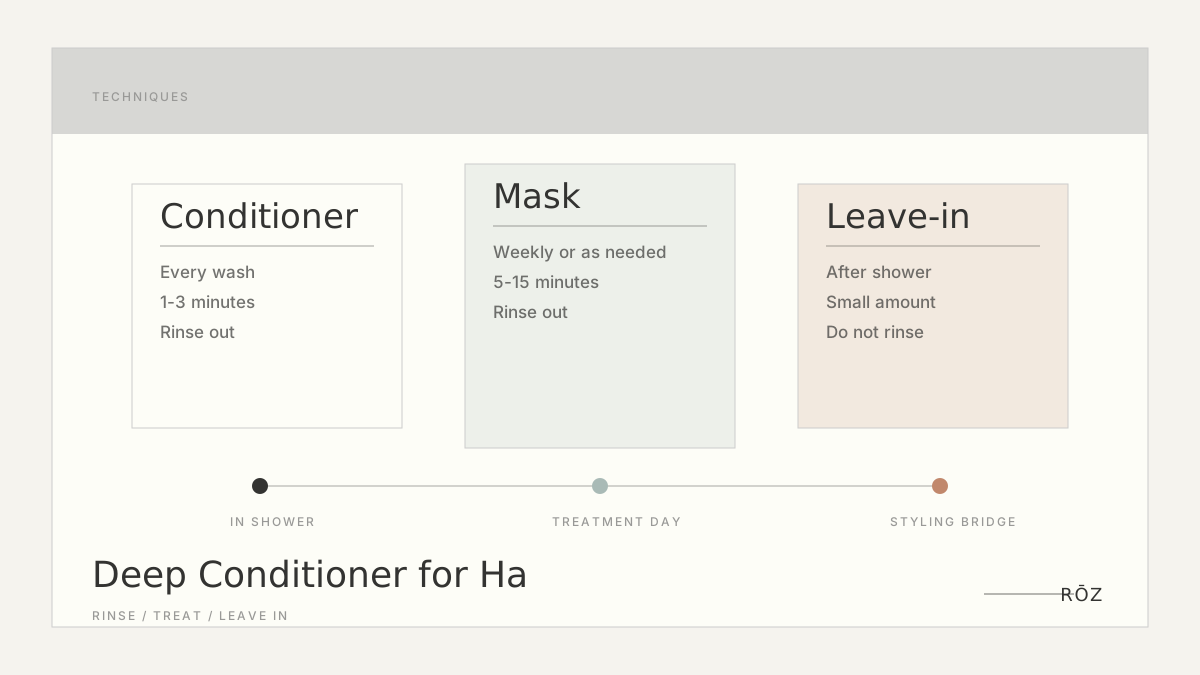
If you are deciding between a deep conditioner for hair, a hair mask, a regular conditioner, and a leave-in conditioner, use the product’s job rather than the name on the bottle.
| Product | Main job | When to use it | Rinse? |
|---|---|---|---|
| Regular conditioner | Fast slip, detangling, cuticle smoothing | Most wash days after shampoo | Yes |
| Hair mask | Richer treatment for roughness, dryness, color, or frizz | Weekly or every other week | Yes |
| Deep conditioner | Mask-like treatment with longer contact time | When hair needs more than daily conditioner | Yes |
| Leave-in conditioner | Post-wash moisture retention, frizz smoothing, styling prep | After rinsing, before drying | No |
In practice, hair mask and deep conditioner usually overlap. Conditioner and leave-in do not. Conditioner works in the shower and rinses away. Leave-in works after the shower and stays on the strand. For the full decision tree, read hair mask vs conditioner.
Source and review note
This deep conditioning guide was produced by the RŌZ editorial team, reviewed through Mara Roszak’s working-stylist perspective, and checked against published hair-fiber research. The cuticle-swelling and porosity language is anchored to Gavazzoni Dias’s overview of hair cosmetics. The conditioning research (cationic surfactants, fatty alcohols, silicone deposition) is sourced from Robbins’s Chemical and Physical Behavior of Human Hair (5th ed., Springer, 2012). Penetration depth and substantivity claims are cross-checked against Cruz et al.’s ceramide-cuticle work and Velasco et al.’s study on hydrolyzed wheat protein uptake. Frequency guidance follows the American Academy of Dermatology consumer recommendations.
Product fit. RŌZ sells Foundation Mask, Foundation Conditioner, and Milk Hair Serum. This page names their practical routine role: weekly treatment step for rough or dry lengths, daily rinse-out slip and softness, and post-wash leave-in smoothing. They support healthier-feeling hair; they are not a bond-builder or a trim substitute.
Experience note. Mara Roszak is a celebrity hairstylist and RŌZ co-founder with two decades of editorial, salon, and red-carpet work. Her review focus here was the difference between mask-as-product and mask-as-technique — the workflow that turns the same bottle into a noticeably better wash day.
What kind of mask routine have you tried?
Most of these fail because the workflow is wrong, not the product. Cross what hasn't worked and read the matching section.
- Slathering mask on dry hair before the shower product slides off — water first
- Leaving a mask on for an hour with no heat extra time returns taper quickly
- Using a mask every wash protein build-up risk on fine hair
- Mask on roots and lengths roots get sebum, ends need the mask
- Ten minutes under a shower cap or warm towel this is the technique that works
- Rinse with cool water at the end closes cuticle, locks in slip
Should you be deep conditioning at all?
Deep conditioning is right for most adults with shoulder-length or longer hair, color-treated hair, hair that gets heat tools more than once a week, and hair that feels rough at the ends within two days of a wash. If you have very fine, very oily hair that feels weighed down 24 hours after a normal wash + condition, deep conditioning weekly may be too much — try every other week with a lighter formula and skip the protein.
A simpler test: pull a single dry strand off your brush and stretch it. If it stretches a small amount and snaps back, you are in maintenance territory and a weekly mask keeps you there. If it stretches a lot then snaps without recovering, you have low protein and high porosity — masks help, but bond builders do more. If it barely stretches and snaps right away, you have high protein and need moisture, not more protein-heavy treatments.
How to deep condition — the six-step method
This is the workflow Mara uses when prepping hair before a shoot. Time it once and the routine adds maybe ten minutes to a normal wash day. Skip the heat step and you have lost most of the value of doing it.
- Wash with shampoo first. Do not skip — the cuticle needs to be free of styling residue and oxidized sebum so the mask can actually deposit. Sulfate-free is fine; double-shampoo if you wear daily product.
- Towel-blot to damp, not soaking. Squeeze a microfiber towel down the lengths twice. Conditioner needs water to spread, but a soaking-wet strand dilutes the mask before it can adsorb.
- Apply mask from mid-shaft to ends, not roots. Use a coin-size pump for short hair, a tablespoon for medium, two tablespoons for long. Distribute with a wide-tooth comb so every strand is coated.
- Add gentle warmth for 10–15 minutes. Best: shower cap + a warm towel wrapped over it. Acceptable: hooded dryer at low. Bare minimum: shower cap alone, body heat does some of the work. Most of the practical benefit happens in this window — longer is not automatically better.
- Rinse with the coolest water you can stand. Cold water encourages the cuticle to lay flat, which is what you actually feel as “shine.” Lukewarm is fine; hot rinses undo most of step 4.
- Skip conditioner after the mask. The mask already conditioned. Apply a leave-in serum on damp ends and proceed to your normal styling routine.
Should you double shampoo before a mask?
For most people, once is enough. Double shampoo when the scalp has been working harder than usual: heavy daily styling product, dry shampoo for two or three days, swimming in chlorine, gym sweat layered onto leave-in, a heavy oiling treatment from the day before. The first lather lifts the surface buildup and barely feels like it cleaned; the second lather, with a much smaller amount of product, actually clears the cuticle so the mask can deposit.
The mistake: double-shampooing every wash, with the same volume both times. That over-strips the scalp and pushes oil production up, which becomes the reason you “need” to double-shampoo next time. Use the technique when the situation calls for it, not as a default.
If you do double, the second pass needs roughly half the product of the first and only ten to fifteen seconds of contact time. The first pass is the dirty job; the second pass is the prep for the mask.
Wet, damp, or dry hair — what actually works
The internet is divided on whether to apply mask to wet or dry hair, and the honest answer is: damp is correct in 95% of cases. Soaking-wet hair dilutes the formula before it can deposit; bone-dry hair has a closed cuticle and the mask sits on top.
The one exception is “pre-poo” treatment with oil-heavy formulas (coconut oil, shea-based masks) on very high-porosity or very curly hair, where applying to dry hair before shampoo lets the oil interact with the fiber before water swelling begins. That is a different technique with a different goal — see our pre-poo treatment guide.
For a normal weekly mask routine: wash, towel-blot, apply, heat, rinse. The damp-strand workflow is the most studied and the most reliable.
How often, by hair situation
| Situation | Mask frequency | Notes |
|---|---|---|
| Maintenance (no color, no heat) | Every 10–14 days | Lighter formula, no protein |
| Weekly color refresh or daily heat | Once a week | Hydration-led mask |
| Bleached, highlighted, or chemically straightened | Twice a week | Alternate hydration mask + bond treatment |
| Postpartum, chemo recovery, sudden shedding | Once a week + scalp evaluation | Talk to a derm; mask is supportive, not curative |
| Very fine or very oily hair | Every 14–21 days | Apply only to ends; avoid protein masks |
| Coily, very high porosity | Twice a week | Lipid-led + sealing oil after rinse |
The wrong way to set frequency is by feel — fine and oily hair often wants less mask but feels rough enough that the user reaches for it weekly. Use the strand-stretch test once a month and adjust from there.
What to look for in a mask, briefly
Skip past the marketing language and look for these ingredient classes on the back of the bottle:
- Cationic surfactants (behentrimonium chloride, cetrimonium chloride) — give the formula its substantivity, the reason conditioner stays bound to negatively-charged damaged hair.
- Fatty alcohols (cetyl, cetearyl, behenyl, stearyl alcohol) — the slip and softness most people associate with “good” conditioner. These are not the drying alcohols people worry about.
- Humectants (glycerin, panthenol, sodium PCA, hyaluronic acid) — help the hair hold water so it feels softer and more flexible.
- Lipids and emollients (squalane, shea butter, plant oils, ceramides) — fill in cuticle gaps and seal the moisture from the humectants.
- Hydrolyzed proteins (wheat, silk, oat, keratin) — temporary structural support. Use sparingly. On already-stiff hair, skip entirely.
- Silicones (dimethicone, amodimethicone, cyclopentasiloxane) — surface smoothing. Not inherently bad, but can build up if your shampoo is too gentle to remove them. Sulfate-free shampoo + heavy silicones can become a buildup problem within 4–6 weeks.
A mask formulated well has 1–2 ingredients from each of the first four classes and uses protein and silicones with intent, not as marketing fillers.
The six mistakes that waste a deep conditioning routine
- Skipping the cap or warmth. Without that steady contact time, much of the conditioner stays near the surface. With a cap or gentle warmth, the formula has a better chance to condition evenly. This is the single most-skipped step.
- Applying to soaking-wet hair. Dilutes the formula. Towel-blot first.
- Putting mask on the roots. Roots get sebum from the scalp; you do not need to add more conditioning there. Mid-shaft to ends only.
- Leaving it on for an hour expecting more benefit. The visible payoff usually tapers after the 10–15 minute window. Longer is not automatically better and overconditioning is real (mushy, limp, no body).
- Using a protein mask on already-stiff hair. If your hair barely stretches, you need moisture, not more protein. Skip the keratin masks.
- Following with rinse-out conditioner. The mask already conditioned. Adding regular conditioner over it is overconditioning.
A mask routine you can actually do
The technique above is what works. The product list below is what we sell. They were designed to fit this wash-day sequence, but the technique works with most decent masks.
- Foundation Mask — weekly mask step for rough, dry, color-treated, or heat-styled lengths. Use on clean, damp hair and leave on 5–10 minutes; add a cap or warm towel when the hair needs extra care.
- Foundation Conditioner — everyday rinse-out conditioner for slip, detangling, and softness on wash days when you skip the mask.
- Milk Hair Serum — leave-in serum after rinsing. Apply a small amount to damp mid-lengths and ends for smoothing, frizz smoothing, and heat-prep support where the format fits.
Frequently asked questions
Frequently asked questions
Is deep conditioner good for your hair?
How often should you deep condition your hair?
How long should I leave a deep conditioner on?
Should I apply deep conditioner to wet or dry hair?
Can I use regular conditioner as a deep conditioner?
How do I tell if my hair needs more deep conditioning?
What ingredients should a deep conditioning mask have?
What are the most common deep conditioning mistakes?
Sources
- Gavazzoni Dias MFR. Hair cosmetics: an overview. International Journal of Trichology, 2015. PMC4387693 — porosity, cuticle behavior, sulfate vs sulfate-free comparison.
- Robbins CR. Chemical and Physical Behavior of Human Hair, 5th edition. Springer, 2012. Conditioning, cationic surfactants, lipid deposition.
- Cruz CF, Costa C, Gomes AC, Matamá T, Cavaco-Paulo A. Ceramide penetration and substantivity in cuticle. International Journal of Cosmetic Science, 2013. PMID 23438077.
- Velasco MV, Dias TC, de Freitas AZ, et al. Hair fiber characteristics and methods to evaluate hair physical and mechanical properties. International Journal of Cosmetic Science, 2009. PMID 19134123 — hydrolyzed protein uptake.
- Marsh JM, Brown MA, Felts T, Hutton HD. Conditioning polymer hydrogen-bonding mechanisms. Cosmetics, 2018. Polymer + keratin interactions in conditioner formulation.
- American Academy of Dermatology Association. Hair care: how often should you wash and condition? aad.org/public/everyday-care/hair-scalp-care. Frequency guidance.
Related guides on the RŌZ Guide
- Hair mask vs conditioner — the product picker for conditioner, mask, deep conditioner, and leave-in.
- Hair oil — what it does, what it doesn’t — the post-mask sealing step explained.
- Bond builders for hair — why bond repair and deep conditioning are different routines.
- How to fix heat-damaged hair — when deep conditioning is enough vs when it is not.
- Sulfate-free shampoo for curly hair — the wash that pairs well with weekly masking on curls.